Loading......

Home > Blogs & Events > Blogs

Business process globalization ,
Localization maturity ,
Continuous Localization

Hyper-Speed? Warp Speed? How Much Faster Can We Go?

August 4, 2021

Rebecca Ray

blog-image

Looking for some research-based guidelines on how to achieve deeper integration of code and content so that you can keep up with software and content developers? The 53 companies that we recently interviewed for our continuous localization research stream had plenty. We share six of their guidelines below.
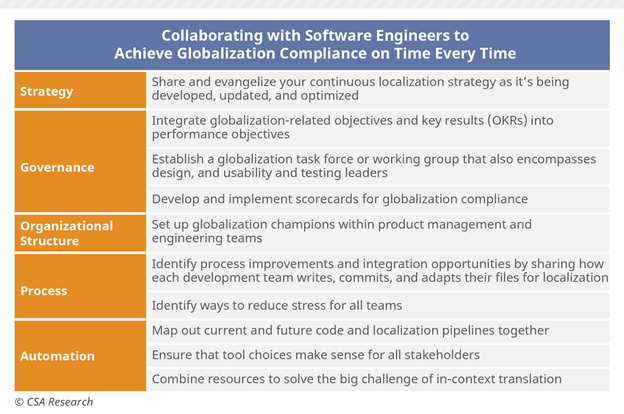
 

  • Make sure that you’re ready. Showstoppers include software developers and content creators not yet 100% responsible for producing and maintaining world-ready deliverables. Messy TMs, unprepared LSPs, and connectors not ready for primetime are also big roadblocks to implementing high-velocity, continuous workflows.
     
  • Don’t build a Ferrari. Newbies should take their time and work with a few (small) engineering or content teams to test their processes. Don’t attempt too many integrations at the beginning. Invest in identifying and vetting the best tools for now and into the future by collaborating with code/content contributors and product managers. Then stick with your selected (cloud) TMS and content repositories but understand that requirements will morph over time.
     
  • Hold continuous development teams accountable. It is up to executives to mandate and provide ongoing, senior-level engagement to ensure that developers are answerable for internationalization. Continuous localization is a no-go when non-globalization-compliant code or content keeps popping up, whether internally from newly acquired or untrained teams or externally from third-party contributors. If it is to be effective, cost-efficient, and sustainable, internationalization enablement must move upstream to function as an integrated component within the development portfolio.
    Picture1
     
  •  Harness AI and machine learning. Mine your own data by automating the analysis of bugs found through TMS. Shift the focus from traditional linguistic testing to analyzing translation memories for expansion and contraction by language based on your specific content types, instead of relying on industry averages. Then apply all of this data to support software and content designers to build components that self-test – in your source language, as well as in others.
     
  • Minimize the content and code that your organization produces and shift left. Concentrate on original design of products, services, and content. Raise visibility for international requirements by implementing a formal process to gather, analyze, and integrate them into product lifecycles where and when they’re needed most. You may achieve continuous localization goals faster by improving original source code quality or by implementing an ongoing internationalization and localization training program for current and newly hired developers and testing staff.
     
  • Pivot from project and program management to product management. Executives depend on localization teams to collaborate with many colleagues throughout the organization to deliver a winning global customer experience – not projects. Managing localization as a product means customer obsession, product roadmaps, and experimentation. Continuous localization becomes one of the processes that enables your team to deliver language as a platform requirement, rather than as an end in itself. It also bestows visibility and recognition on localization product managers, opening up career advancement opportunities.
     

And last, but not least, eliminate continuous localization altogether for individual content categories. For example, hold off on translating technical documentation or support knowledge bases until A/B testing and analytics detect a real customer need. If you support several verticals with enterprise software that can be customized, consider allowing customers to access your MT engines under a self-serve model. Then measure the change in demand for translation and make future decisions based on data.
 

Stay Informed with CSA Research

Subscribe to our newsletter for updates on the latest research, industry trends, and upcoming events.

Subscribe

Ready to Explore CSA Research Insights?

Access exclusive data, reports, and analysis that power smarter decisions across the global content industry.

Reliable
Comprehensive
Data-Driven
Research
Visit the platform

Meet Our Analyst

writer_profile_image

Rebecca Ray

Director of Buyers Service

A former Rotary International scholar and Silicon Valley veteran, Rebecca co-authored Doing Business in the USA, a book for global high-tech companies.

Connect with Rebecca Ray

Recent Blogs

Turn Research Into Action

Our consulting team helps you apply CSA Research insights to your organization’s
specific challenges, from growth strategy to operational excellence.