Home > Blogs & Events > Blogs
May 20, 2021

It is no secret that machine translation (MT) has gone from a relatively niche solution to seeming ubiquity in just a few short years. A forthcoming report from CSA Research on MT use at language services providers shows a 51% increase in adoption since 2019, with over two-thirds of LSPs now using it openly. Similarly, cloud translation management system (TMS) developers reported that 2020 was the year when the majority of segments that they process involved MT. At the same time, our survey reveals that LSPs in general process less than one-quarter of their volume with MT, indicating that many LSPs are considerably less tech-savvy than those that use cloud TMSes and that professional use of MT still has considerable room to grow in the market.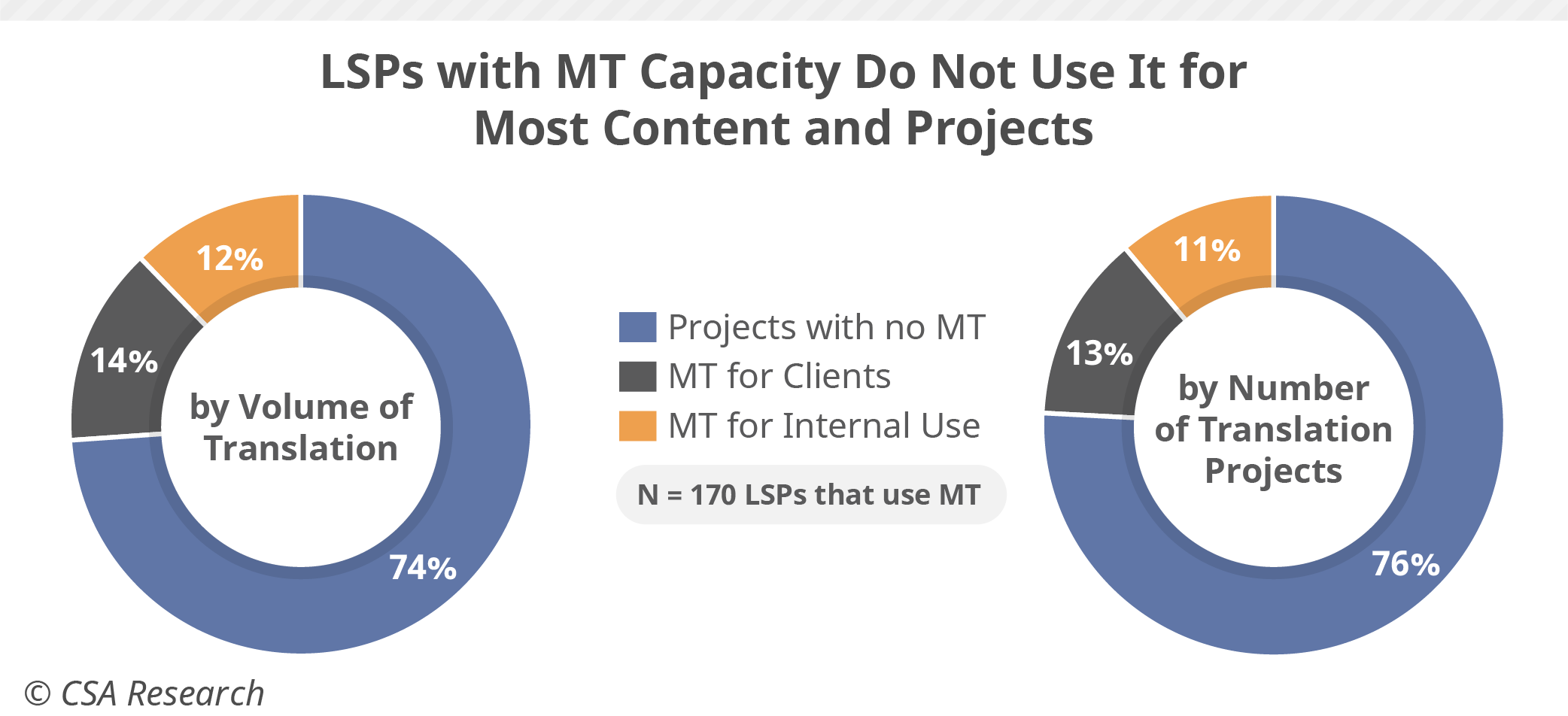
On the enterprise side, organizations still wrestle with when and where to use MT and which variety – raw (unedited), lightly post-edited, or fully post-edited – they should use. Different industries are more or less open to it, but the COVID-19 pandemic appears to have pushed adoption forward by several years as organizations scrambled to deal with uncertain budgets alongside urgent and exploding demand to provide content to customers in multiple languages. Others worry about how to manage risk or determine where to focus their human-in-the-loop translation efforts.
This period of growth and experimentation is enabled by dramatic breakthroughs that have made MT far more capable than it was just a few years ago. At the same time, some media claims about MT reaching “human parity” remain overblown and many companies make untenable claims about how they can use machine translation – and artificial intelligence in general – for as-yet unproven use cases.
To address these gaps in knowledge, CSA Research is working with the American Machine Translation Association (AMTA) on a survey of various groups, from enterprises to LSPs to freelance linguists, about how and why they do – or do not – use MT. We need your help to build a reliable and representative sample of each of these groups in order to provide a 360° view of how MT is transforming the language sector. We invite you to visit https://www.surveymonkey.com/r/CSA-MT and complete this survey. Because this topic is so important, every respondent who leaves their name and email address will receive a copy of the survey results and CSA Research will present them at the MT Summit in August of this year.
So please take a few moments to tell us about how you use MT and why. If you don't use it, we still want to hear from you. Your feedback will help us build a comprehensive picture of this technology and its role in the language industry. And if you develop MT technology, please contact Dr. Arle Lommel (arle@csa-research.com) to set up a time to discuss your perspective with him directly.
Subscribe to our newsletter for updates on the latest research, industry trends, and upcoming events.
Subscribe
After obtaining a BA in linguistics in 1997, I began working for the now-defunct Localization Industry Standards Association (LISA), where I headed up standards development and worked on quality assessment models. At the same time, I completed a...
Connect with Arle LommelOur consulting team helps you apply CSA Research insights to your organization’s
specific challenges, from growth strategy to operational excellence.